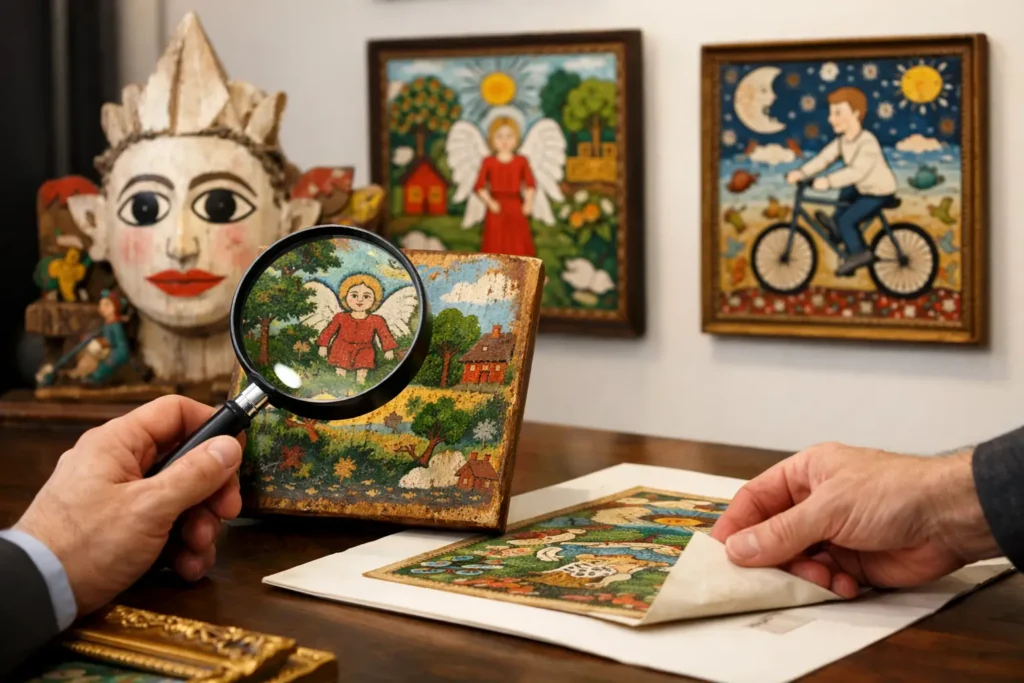
A genuine Howard Finster work rarely sits quietly in a room. It speaks up. The text pulls you in, the color keeps your eye moving, and the imagery carries that unmistakable mix of urgency, faith, humor, and invention that made Finster one of the most recognizable self-taught American artists of the 20th century. If you are searching for Howard Finster art for sale, you are not just shopping for a decorative object. You are stepping into a body of work with personality, conviction, and real collecting history behind it.
That matters, because Finster is one of those artists whose work feels instantly accessible while still rewarding a more careful eye. Some buyers are drawn to the spiritual messaging. Others respond to the folk-art energy, the historical importance, or the way his paintings electrify a home, office, or collection wall. Whatever brings you to his work, buying well starts with understanding what makes one piece different from another.
Why Howard Finster Still Connects With Collectors
Finster occupies a rare place in American art. He is celebrated by folk art collectors, admired by contemporary buyers, and familiar even to people who are not deep in the art world. His images can feel homemade and visionary at the same time. That tension is part of the appeal.
Unlike artists whose market depends on distance or theory, Finster’s work meets people where they live. It is bold, direct, and emotionally legible. You do not need a lecture to understand that it has conviction. For many collectors, that is exactly the point. They want art with a pulse, a voice, and a point of view.
His legacy also reaches beyond traditional folk art circles. Finster’s visibility in American culture gave him a broader audience than many self-taught artists ever achieve. That wider recognition helps sustain demand, but it also means buyers should approach the market with care. Familiar names attract attention, and attention creates a range of quality, pricing, and provenance across what is available.
Howard Finster Art for Sale: What Changes Value?
Not every Finster work lands in the same place, aesthetically or financially. When buyers ask why one piece commands more interest than another, the answer usually comes down to a handful of factors working together.
Subject matter matters
Certain themes are especially associated with Finster – biblical scenes, portraits, angels, historical and cultural figures, visionary imagery, and densely written text. Works that feel strongly representative of his visual language tend to attract the most attention. Buyers often want a piece that looks unmistakably like Finster, not something that only hints at him.
That does not mean quieter or less typical works lack value. In fact, some seasoned collectors are drawn to unusual examples because they expand the story of the artist. But for many people buying their first piece, iconic imagery carries lasting appeal.
The strength of the composition
With Finster, busyness alone is not enough. The best works have internal rhythm. The words, faces, symbols, and color fields all push together in a way that feels alive rather than cluttered. A strong composition can make even a modestly scaled work feel important.
This is where gallery guidance is useful. Two works may share similar themes, dates, or dimensions, yet one simply has more energy. That kind of difference can be hard to explain in a spreadsheet and very obvious in person.
Condition and medium
Condition always matters, but it matters differently depending on the work. Finster used varied supports and materials, and some natural wear may be expected in older examples. Still, buyers should understand whether condition issues are minor signs of age or problems that affect long-term enjoyment and value.
Medium can also influence desirability. Paintings, drawings, and mixed-media works may appeal to different collectors at different price points. A buyer furnishing a first serious collection may prioritize visual impact, while a more experienced collector may focus on rarity, period, or medium-specific significance.
Provenance and authenticity
This is the serious part of the conversation. With any well-known artist, documentation matters. A work’s history of ownership, exhibition background, inscriptions, and other supporting details can all strengthen buyer confidence. Finster’s work is distinctive, but distinctiveness is not a substitute for proper vetting.
If you are considering Howard Finster art for sale, ask clear questions. What is known about the piece? Has it been previously sold by a reputable gallery? Are there signatures, inscriptions, dates, or other identifying features? Trust is built through transparency, not vague enthusiasm.
Buying Finster for Your Home Versus Your Collection
These are not always the same decision, and that is perfectly fine.
Some buyers want the strongest available example within their budget because they are building a collection with long-term depth. Others want a work that transforms a hallway, anchors a living room, or gives a creative office real identity. Finster can do both. His work has enough art-historical importance to satisfy a collector and enough visual electricity to satisfy someone who simply wants to live with something unforgettable.
The trade-off is usually between purity and personal fit. A highly collectible piece may not be the one that feels best in your space. A slightly less canonical work might be the one you think about for weeks after seeing it. Good buying often happens where those two instincts meet.
How to Look at a Finster Work in Person
Photos help, but Finster is better in the room. His surfaces, hand, pacing, and written passages often read differently when you are standing in front of them. What seems chaotic online can feel deeply structured in person. What looks small on screen can have surprising presence.
Scale is especially important. Finster’s work can carry a lot of information, and size affects how that information lands. A compact work may feel intimate and almost diary-like. A larger piece can become the whole conversation in a room.
Color also deserves an in-person look. Digital images flatten things. Finster’s palette can be joyous, sharp, even a little unruly, and that liveliness is part of the experience. For Chicago-area buyers, or anyone who values a relationship-led approach, seeing work through a trusted gallery setting often leads to a more confident decision than scrolling through anonymous listings.
Price Expectations and the Reality of the Market
Collectors naturally want to know what a fair price looks like. The honest answer is that it depends on the quality of the piece, the period, the medium, condition, subject, and how strongly it represents what buyers seek in Finster’s work.
There is no single number that tells the whole story. Lower-priced works may offer an accessible entry point, especially for newer collectors. More exceptional pieces can command stronger pricing because they combine visual impact, clear authorship, and collectible importance. The key is not chasing the cheapest example. It is understanding whether the work in front of you earns its price.
That is where a good gallery can make a real difference. Experienced guidance helps buyers separate a merely available work from a genuinely compelling one. At David Leonardis Galleries, that kind of personal, curatorially grounded perspective is part of what makes buying art feel less intimidating and more rewarding.
What Makes a Howard Finster Purchase Feel Right
It is usually not only about market logic. The right Finster piece tends to announce itself. You read the text once, then again. A face, a phrase, or a strange little symbol stays with you. You begin thinking about where it would live, how it would change the room, what it says about your taste and your curiosity.
That emotional response matters, especially with an artist like Finster. His work was never meant to be blandly agreeable. It was meant to communicate. So while authenticity, condition, and value should absolutely guide the purchase, there is also room for instinct. If a piece has that unmistakable charge, and the facts around it are solid, that combination is often worth paying attention to.
For buyers who want art with story, cultural presence, and real visual personality, Finster remains a compelling place to land. Buy with your eyes open, ask good questions, and give yourself the chance to stand in front of the work before deciding. The best pieces do more than fill a wall. They keep talking.